I had lived forty years as a woman, birthed five children. My entire identity was wrapped up in being a mom—not just the title, but everything that came with it. I was the nurturer. The emotional center of the home. The one who anticipated needs, who created safety, who held space for everyone’s feelings.
When I started to accept that I was transgender and that I was actually a man, I could not wrap my head around how I could ever consider walking around the world as my truest self.
Because if I wasn’t the mom—the caregiver, the emotional anchor—who was I? And more troubling: Could I even be those things as a man?
Looking back, I realize how unconscious bias nearly derailed my transition. I had some deeply ingrained beliefs about what it means to be a man and a father. And I’m still unpacking them.
The Invisible Rules I Didn’t Know I Was Following
For months after my realization, I was paralyzed. Not just by fear of others’ reactions, though that was certainly present. I was paralyzed by my own internal narratives about masculinity, fatherhood, and what kind of person gets to be caring, sensitive, and emotionally present.
Growing up, my dad did the cooking and cleaning. He was physically present and took care of practical tasks. But he wasn’t the one doing the nurturing. He wasn’t the one doing the emotional labor in our home. That was my mom’s domain—checking in on feelings, creating emotional safety, noticing when something was wrong, carrying the mental load of everyone’s wellbeing.
I had absorbed a clear message: Men can be helpful. Men can be providers. Men can even be hands-on parents. But the deep nurturing, the emotional attunement, the person who holds the family’s heart? That’s a mother’s role.
And I had been that person for years.
So when I realized I was a man, I faced an impossible equation: If I transitioned, could I still be the emotionally present, nurturing parent my children needed? Could I be sensitive and caring and still be seen—and see myself—as a man? Or would I have to choose between my authentic gender identity and my authentic way of showing up in the world?
The Prison of “Supposed To”
The bias wasn’t just about gender roles in general. It was deeply personal and specific.
I believed:
- “Real men don’t center emotional connection the way I do.”
- “Fathers love their kids, but they don’t nurture like this.”
- “If I’m this sensitive, this attuned, this focused on emotional labor—maybe I’m not really a man after all.”
- “Stay-at-home dads are rare, and they’re certainly not like me.”
- “Men who are caring and nurturing are the exception. And I’m too much of both to qualify.”
The cruel irony wasn’t lost on me. I was raising my children to reject limiting beliefs about who they could become, to embrace the full range of their humanity regardless of gender. Yet I was holding myself to an impossibly narrow definition of manhood—one that left no room for my most authentic qualities.
The Beliefs That Still Whisper
Here’s what I’m still learning: Unconscious bias doesn’t disappear the moment you name it. Even now, years into my transition, I catch myself questioning whether I’m “man enough” because I’m the one who remembers everyone’s appointments, who notices when someone’s energy is off, who creates the emotional infrastructure of our home.
I’ve embraced this part of myself more fully, yes. I’ve claimed my identity as both a man and a deeply nurturing parent. But the unpacking continues.
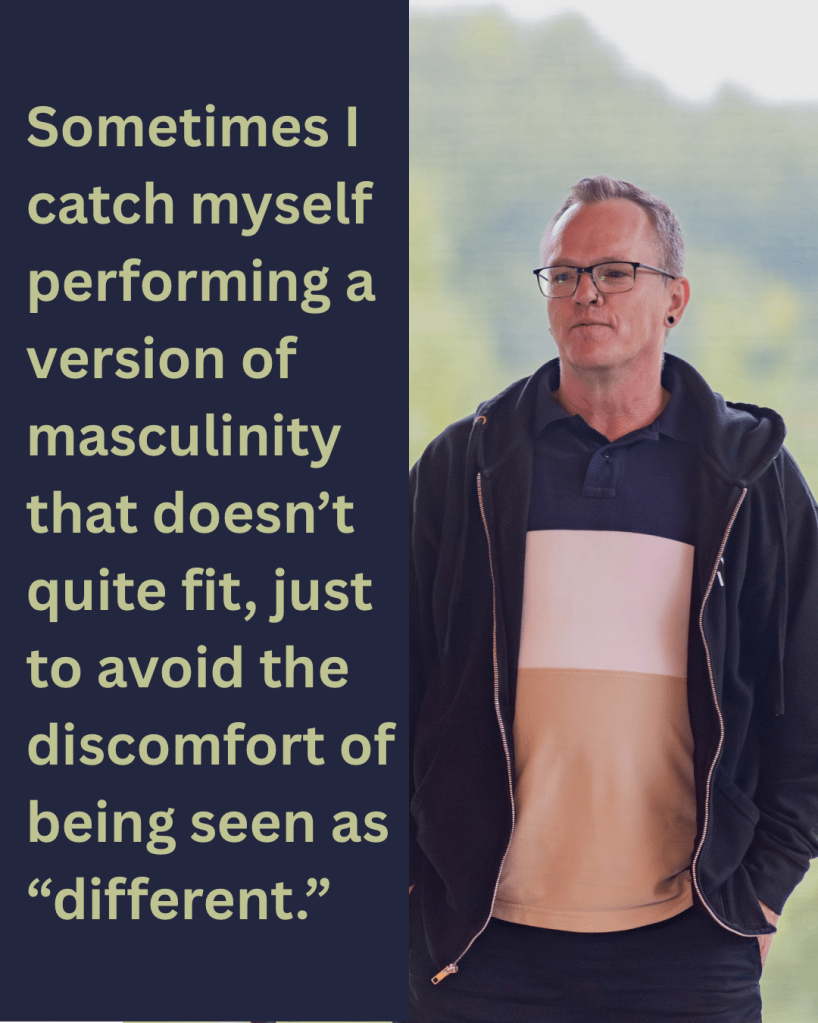
Sometimes I’m in a room with other dads and I notice myself pulling back from talking about the emotional aspects of parenting. Sometimes I wonder if my sensitivity makes me less legitimate. Sometimes I catch myself performing a version of masculinity that doesn’t quite fit, just to avoid the discomfort of being seen as “different.”
This isn’t a story with a tidy ending. It’s ongoing work. And that’s the point.
What This Really Means
Unconscious bias isn’t just about how we view others. Often, the most damaging biases are the ones we hold about ourselves—the invisible rules we follow without even realizing they’re there.
And here’s what I’ve learned: These biases show up everywhere.
You might not be navigating a gender transition. But I guarantee you’re carrying unconscious beliefs about yourself—rules about who you’re allowed to be, what traits are “acceptable” for someone like you, what paths are available given your identity or history.
Maybe you believe:
- Career changers: “People who are nurturing and empathetic don’t make good leaders. I should be tougher if I want to advance.”
- Creatives: “Artists aren’t practical. If I’m good with money and logistics, maybe I’m not a real creative after all.”
- Parents returning to work: “If I was fulfilled being home with my kids, wanting a career now means I’m abandoning what matters most.”
- Men in caregiving roles: “Real men don’t make eldercare or nursing their calling. That’s women’s work.”
- Women in technical fields: “If I’m collaborative and relationship-focused, I won’t be taken seriously in this male-dominated industry.”
- Empty nesters: “I was ‘just’ a stay-at-home parent. I don’t have anything valuable to offer the professional world now.”
These beliefs feel like facts. They feel like the truth about reality. But they’re not. They’re unconscious bias dressed up as wisdom.
The Turning Point (And the Ongoing Practice)
My breakthrough came when I started examining where these beliefs actually came from—and recognizing they were stories, not truths.
Who says a man can’t be the emotional center of his family? Who decides that nurturing and masculinity are incompatible? Why did I assume my dad’s version of manhood was the only valid one?
The answer was clear: These were cultural narratives I’d absorbed, not universal laws. And I got to decide whether they applied to me.
But here’s what I didn’t expect: Making that decision once wasn’t enough. I have to keep making it. Every time the old beliefs resurface, every time I catch myself shrinking or performing or questioning my legitimacy, I have to consciously choose my truth again.
This is the real work of transformation. It’s not a single moment of insight. It’s a practice of returning, again and again, to who you actually are—even when the world (and your own internalized messages) suggest you should be something else.
Living as My Truest Self (While Still Unpacking)
Today, I am a father. I am a man. And I am deeply nurturing, sensitive, and emotionally present with my children and partner.
My children didn’t lose anything when I transitioned. They gained a parent who models authenticity, courage, and the willingness to challenge limiting beliefs—even the beliefs that persist. They see someone who refuses to choose between being genuine and being accepted, who keeps showing up fully even when it’s uncomfortable.
And they’re learning that all people—regardless of gender—contain multitudes. That men can be soft and strong, emotional and steady, nurturing and authoritative. That there’s no one way to be anything.
But I’ll be honest: I’m also modeling the struggle. They see me catch myself, question myself, work through my own biases in real time. And maybe that’s even more valuable. Maybe seeing the ongoing practice of self-acceptance is the most important lesson of all.
The Work of Becoming
Uncovering and challenging unconscious bias requires:
Honest self-examination. What stories are you telling yourself about who you are and what you’re capable of? Where did these stories come from? Whose voice are you hearing when you tell yourself you can’t, shouldn’t, or aren’t qualified?
Willingness to sit with discomfort. Challenging long-held beliefs feels destabilizing. You might feel exposed, uncertain, even fraudulent at first. That discomfort is part of growth, not evidence you’re on the wrong path.
Compassion for yourself. You absorbed these beliefs for a reason—often as protection, belonging, or survival. Thank them for their service, and then decide if they still serve you. And be patient with yourself when they resurface. Unpacking bias is ongoing work, not a one-time achievement.
Recognition that you’ll revisit this work. Some days you’ll feel solid in your authentic identity. Other days, old doubts will creep back in. Both are part of the process. The goal isn’t to never struggle—it’s to keep choosing yourself even when you do.
Support from others. We can’t always see our own blind spots. Sometimes we need someone to hold up a mirror and ask, “Is that really true? Who told you that? What if the opposite were possible?”
An Invitation
If you’re feeling stuck, unfulfilled, or like you’re performing a version of yourself that doesn’t quite fit—even if you can’t quite name why—unconscious bias might be playing a role.
The beliefs you carry about yourself, about what’s possible, about who you’re “supposed” to be given your gender, background, history, or identity—these might be the very things keeping you from the life you’re meant to live.
This shows up in countless ways:
- The entrepreneur who believes being empathetic means they can’t be a strong business leader
- The executive who thinks showing vulnerability will undermine their authority
- The stay-at-home parent who believes their skills “don’t count” in the professional world
- The career-focused person who wants to slow down but fears being seen as uncommitted or lazy
- The naturally introverted person in an extrovert-dominated field who keeps trying to be someone they’re not
- The person from a working-class background who can’t shake the feeling they don’t belong in professional spaces
I work with people who are ready to examine these beliefs, to challenge the narratives that no longer serve them, and to step into their truest selves. Not despite their complicated identities, but because of them. Not by performing someone else’s version of success, but by defining what authentic success looks like for them.
Your path doesn’t have to look like anyone else’s. Your strengths don’t have to fit a conventional mold. The question isn’t whether your authentic self is “acceptable” or “legitimate” or “man enough” or “professional enough” or “successful enough.”
The question is: Are you willing to challenge the beliefs that say it’s not?
And are you willing to keep challenging them, even when they resurface?
Ready to explore what unconscious bias might be costing you? Let’s talk. I work with people navigating identity, career transitions, and the gap between who they are and who they’ve been told they should be. Book a free discovery call to discuss how coaching can help you identify and overcome the hidden beliefs keeping you from your most authentic life.
Discover more from Dean Rasmussen Coaching and Consulting
Subscribe to get the latest posts sent to your email.
