
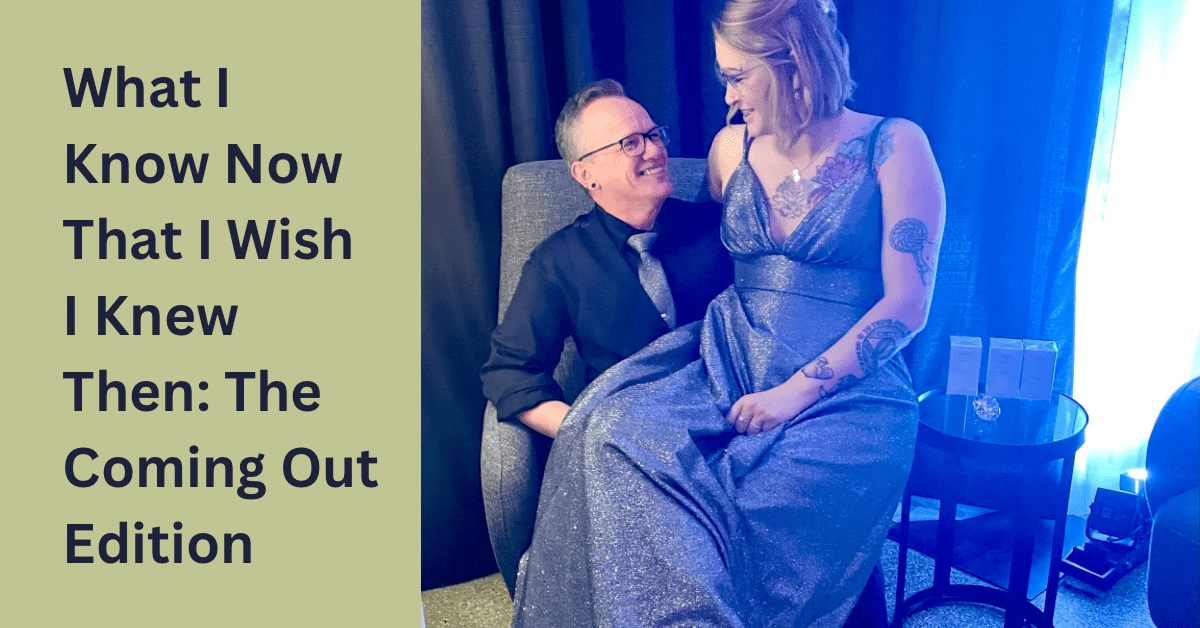
Eight years ago, I wrote about coming out. About getting married at 21, having kids, falling for a friend at 25 and finally FINALLY seeing myself clearly. About the church, the “healing,” the second marriage, and coming out again at 38.
I ended that post at 40, saying I was finally living, loving and being true to myself.
And I was. But honestly? I was also still figuring out what that even meant.
Now I’m 48, and I know things I really wish someone had told me at 25. Or 38. Or even 40.
So this one’s for anyone who’s in the middle of their own becoming, wherever that finds you.
Sexuality Is More Complicated Than a Label
When I came out the first time, I thought coming out was the finish line. Like once you named it, you were done. Gay. Straight. Bi. Pick one, plant your flag, move on.
Nobody told me that sexuality is a spectrum. That it can shift over time. That two people can both identify as gay and have completely different experiences of attraction, desire, and connection. That attraction isn’t one thing, it’s several things, and they don’t always point in the same direction.
I didn’t have language for any of that at 25. I barely had language for it at 38.
Sexual Attraction and Romantic Attraction Are Not the Same Thing
This one would have changed everything for me, earlier.
Sexual attraction is about who you want physically. Romantic attraction is about who you want to build closeness with, who you want to come home to, who you want to know you.
These two things can point at the same person. But they don’t have to. And for a lot of people, myself included, understanding that distinction unlocks a kind of self-knowledge that “am I gay or straight” never could.
You can be romantically attracted to someone without sexual attraction. You can experience sexual attraction without wanting emotional intimacy. You can be somewhere in between, or fluid, or none of the above on any given day.
When I look back at my life before I came out, I can see myself trying to solve the wrong equation. I kept asking who am I attracted to when the more useful questions were what does attraction actually feel like for me and what do I actually need in connection with another person.
Being Demisexual — And Why It Matters
Here’s one I really wish I’d had words for.
Demisexuality is when sexual attraction only develops after an emotional bond is already in place. Not as a preference. Not as a choice. As an orientation.
Looking back at my own life, this describes so much of my experience. The people I’ve been drawn to were people I already knew deeply. The attraction came after the connection, not before it.
Without that framework, I spent years wondering if something was wrong with me. Why didn’t I respond to people the way it seemed like everyone else did? Why did connection always have to come first?
It wasn’t a flaw. It was just how I’m wired.
If you’ve ever felt like you were broken because attraction doesn’t work for you the way it seems to work for everyone else, there’s probably a word for what you experience. And finding that word can be quietly life-changing.
The Saboteurs That Were Running the Show
Here’s something I couldn’t have told you at 25 or 38, not because I wasn’t living it, but because I didn’t have the framework yet.
I now work as a Positive Intelligence coach, and one of the core concepts in that work is the idea of Saboteurs. These self-sabotaging patterns we develop to protect ourselves end up costing us more than they save.
My top two are the Pleaser and the Avoider.
The Pleaser kept me performing a life that looked right to everyone around me. The Avoider helped me not look too closely at the parts of myself that felt too hard, too complicated, too risky to examine.
Together, those two ran a lot of the show during the years I wasn’t living authentically. Not because I was weak. Because those patterns were adaptive and they helped me survive environments that didn’t feel safe for the real me.
But survival strategies have a shelf life. At some point, the thing that protected you starts to be the thing that keeps you stuck.
Coming out, really coming out, not just naming a label but actually inhabiting your own life, often means starting to notice which of your patterns are still serving you and which ones you’ve outgrown.
That’s the work I do with clients now. And it is some of the most meaningful work I’ve ever done.
Curious to learn what your Saboteurs are?
Take the Saboteur Assessment
What I’d Tell My 25-Year-Old Self
You don’t have to have it figured out to start being honest.
The label doesn’t have to be permanent. The answers don’t have to be clean. You are allowed to be in process and being in process doesn’t mean you’re failing.
There are words for what you’re experiencing that haven’t reached you yet. There are people who will understand things about you before you understand them yourself. There are frameworks and tools that will make the inner landscape less terrifying to look at.
And there is nothing wrong with you that understanding yourself won’t help.
Coming Home to Yourself Is a Practice, Not a Moment
I spent a long time treating coming out as an event. A thing that happened, a before and after.
What I know now is that it’s more like a direction. Something you keep orienting toward. A continual choice to be honest with yourself even when it’s uncomfortable, to let yourself be known even when it feels risky, to keep asking who am I, actually rather than settling for whoever was easiest to be. Eight years later, I’m still practicing. And I’m more at home in myself than I’ve ever been.
If you’re somewhere in that process, early, middle, or later than you expected, I see you. And I’d love to walk alongside you.
Ready to stop performing and start becoming?
If something in this post landed for you, coaching might be the next right step. I work with people who are navigating spaces that weren’t built for them and figuring out who they are, what they want, and how to build a life that actually fits.
Book a free discovery call and let’s talk.
Discover more from Dean Rasmussen Coaching and Consulting
Subscribe to get the latest posts sent to your email.
